In my classes and my personal life, I love writing by hand. While plenty of studies show the value of writing by hand, I also understand the appeal of the efficiency of writing digitally. It feels a little rebellious and very creative to step away from every act being geared toward the profitability drive that capitalism has imposed on all areas of our life. Doodling in margins of gorgeous journals, choosing between favorite pens and pencils, and lingering in the physical sensation of writing by hand grounds me.
Whatever you call it, let’s go with simply “writing,” and however you do it, – pen and paper or digitally – a personal writing practice works wonders for everyone. It’s a transformative experience no matter what your approach – simply enjoying the process or strengthening your writing skills for projects you’d like to publish, or as a creative outlet to support other endeavors. The powerful effects of stream-of-consciousness, full-on rambling, blathering and unrelated tangents are always amazing.
Unlike everyday life, where we edit and tweak for politeness, strategic efficiency, space limits and business rules, in a personal writing practice there is the freedom of having no concern for spelling, grammar or transitions to new topics. There’s room for messy ranting, swearing, whining and weeping. It’s also great for boasting, gloating, dreaming big and planning to make the dreams a reality. (Note: you can’t whine too long on paper or you naturally begin to bore yourself and write about possible solutions.)
With the nearly constant bombardment of demands in life and messages and information in our digital world, a few minutes on the page gives you quality time with your own mind and feelings. The conversation with yourself gives you the opportunity to be a patient, listening friend to yourself. It connects you, to you – the most important relationship you’ll ever have, and the one that makes you better at relating to others.
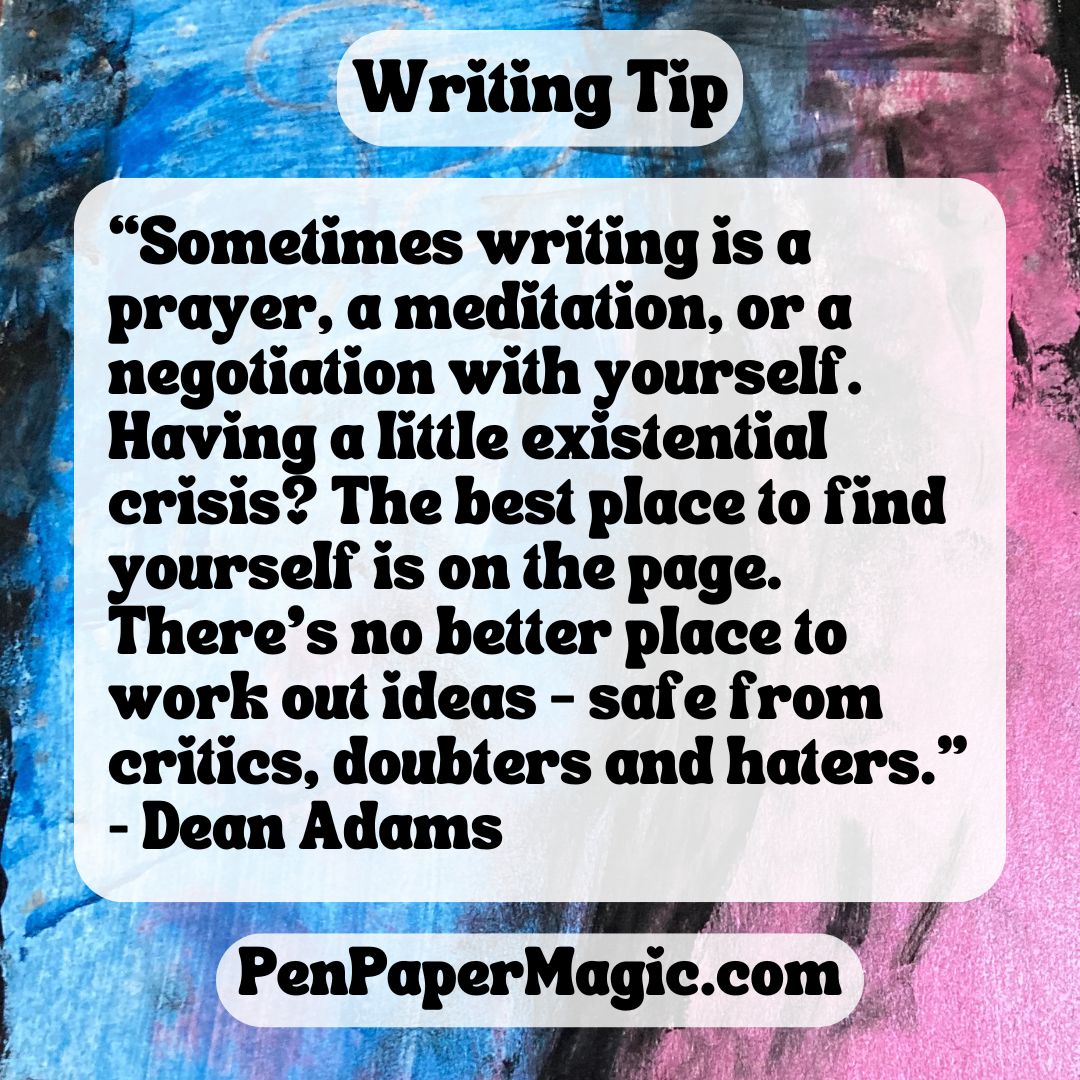
Sometimes writing is a prayer, a meditation, or a negotiation with yourself. Having a little existential crisis? The best place to find yourself is on the page. There’s no better place to work out ideas – safe from critics, doubters and haters.
Putting pen to paper is stepping up and saying yes to the big “I am. I exist.” It’s claiming yourself, your life, your thoughts, your feelings, your power and purpose. It’s more than the very adult sounding “taking responsibility for your life” – it’s an act of radical self-care to honor yourself with the time and effort to really get to know yourself. It’s bravely stepping around our culture’s limiting idea of only some people qualifying for the joy of being a writer or artist, and relegating the rest of humanity to only observing and admiring.
As the pen moves across the page, the topics may range from the mundane to the esoteric. The physical act of writing shifts energy from ruminating thoughts looping over and over to details, emotions, facts, possibilities – words on paper, now more tangible for contemplation and motivation.
I’ve found a positive side effect of a consistent writing practice is better conversations. When I’m not writing regularly, I chit chat more about trivial things, and sometimes feel I’ve wasted opportunities for more meaningful conversations simply because my head isn’t as clear and focused. For me, daily writing gets the negative and petty stuff on the page instead of spreading it around to the people in my life.
After 27 years, I’ve wondered at times if people still need a writing class like mine – especially now with so much of our life being shared on social media. But every time I reach a point where I start to believe that my classes are less relevant, something usually happens that reminds me of the amazing effect of writing in my own life and in my students’ lives. I’ve had former students send me songs that began as a writing exercise in class, email me later to tell me about very real and life-changing epiphanies they had during class or their writing practice that began there… these stories happen often enough that I am steered back to scheduling new classes.
The real beauty, value and purpose of writing, and any art form, is not the final product or the reader’s response. It’s not the branding or the number of readers or attendees or web hits or units sold. It’s the joy of the actual act, even when it feels messy, and the transformation of the writer from the experience. And art will transform you – writing regularly will change your life. That’s why we procrastinate or rush to it, often simultaneously – it’s scary and exciting and shines the light on what we already know: that we must keep evolving. Rapid evolution and radical self-care are really what we all need and what the world needs from us.
To learn more about my classes and coaching please visit PenPaperMagic.com.
 Dean Adams Writes