Hard Days of Winter

“Our task is to say a holy yes to the real things of our lives as they exist.” – Natalie Goldberg

These are my hard days. January has always been a long month with some recurring seasonal depression. The month is a minefield of sentimental dates: the date of my mother’s passing on January 14 and her birthday January 23; the January 25 birthday of my sister who passed 12 years ago; and the anniversary of the loss of a pet. And we all have things we’re struggling with that we don’t share. 

Also, it’s been cold. Really cold. So cold they closed the schools. So cold you could get frostbite in 10-30 minutes. Negative temperatures and wind chills. I’m a southerner living in rural southeast Wisconsin. I’ve generally had a great attitude about winter, but this year the extreme temperatures are making the hard days harder. 

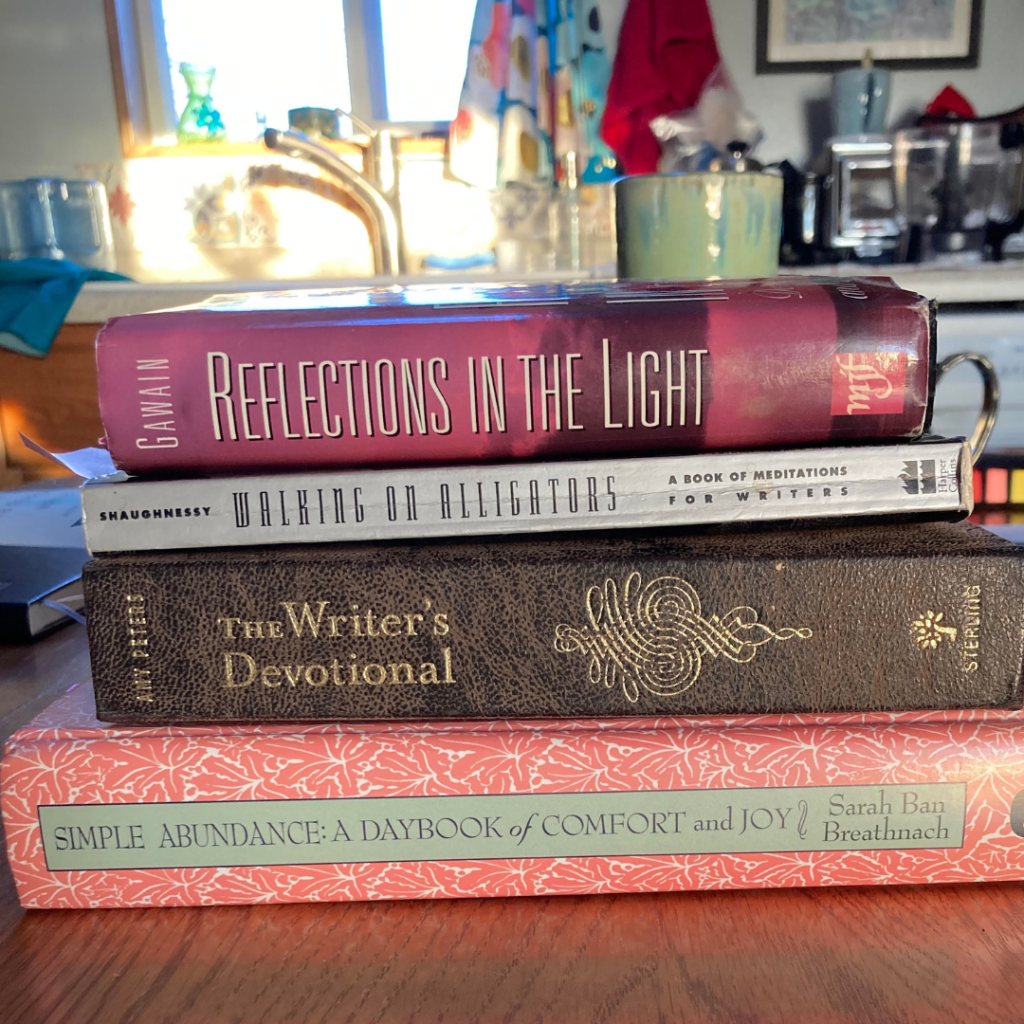
To get I’ve pulled out all my tricks, tools and acts of radical self-care. Here’s what’s currently helping me: 

The days are getting longer and the hard days end with my own birthday on January 29. I always enjoy my birthday and ignore all the negativity about aging. It’s a privilege I celebrate with a holy yes.
The Freedom of a Personal Writing Practice

In my classes and my personal life, I love writing by hand. While plenty of studies show the value of writing by hand, I also understand the appeal of the efficiency of writing digitally. It feels a little rebellious and very creative to step away from every act being geared toward the profitability drive that capitalism has imposed on all areas of our life. Doodling in margins of gorgeous journals, choosing between favorite pens and pencils, and lingering in the physical sensation of writing by hand grounds me. 

Whatever you call it, let’s go with simply “writing,” and however you do it, – pen and paper or digitally – a personal writing practice works wonders for everyone. It’s a transformative experience no matter what your approach – simply enjoying the process or strengthening your writing skills for projects you’d like to publish, or as a creative outlet to support other endeavors. The powerful effects of stream-of-consciousness, full-on rambling, blathering and unrelated tangents are always amazing. 

Unlike everyday life, where we edit and tweak for politeness, strategic efficiency, space limits and business rules, in a personal writing practice there is the freedom of having no concern for spelling, grammar or transitions to new topics. There’s room for messy ranting, swearing, whining and weeping. It’s also great for boasting, gloating, dreaming big and planning to make the dreams a reality. (Note: you can’t whine too long on paper or you naturally begin to bore yourself and write about possible solutions.)

With the nearly constant bombardment of demands in life and messages and information in our digital world, a few minutes on the page gives you quality time with your own mind and feelings. The conversation with yourself gives you the opportunity to be a patient, listening friend to yourself. It connects you, to you – the most important relationship you’ll ever have, and the one that makes you better at relating to others.

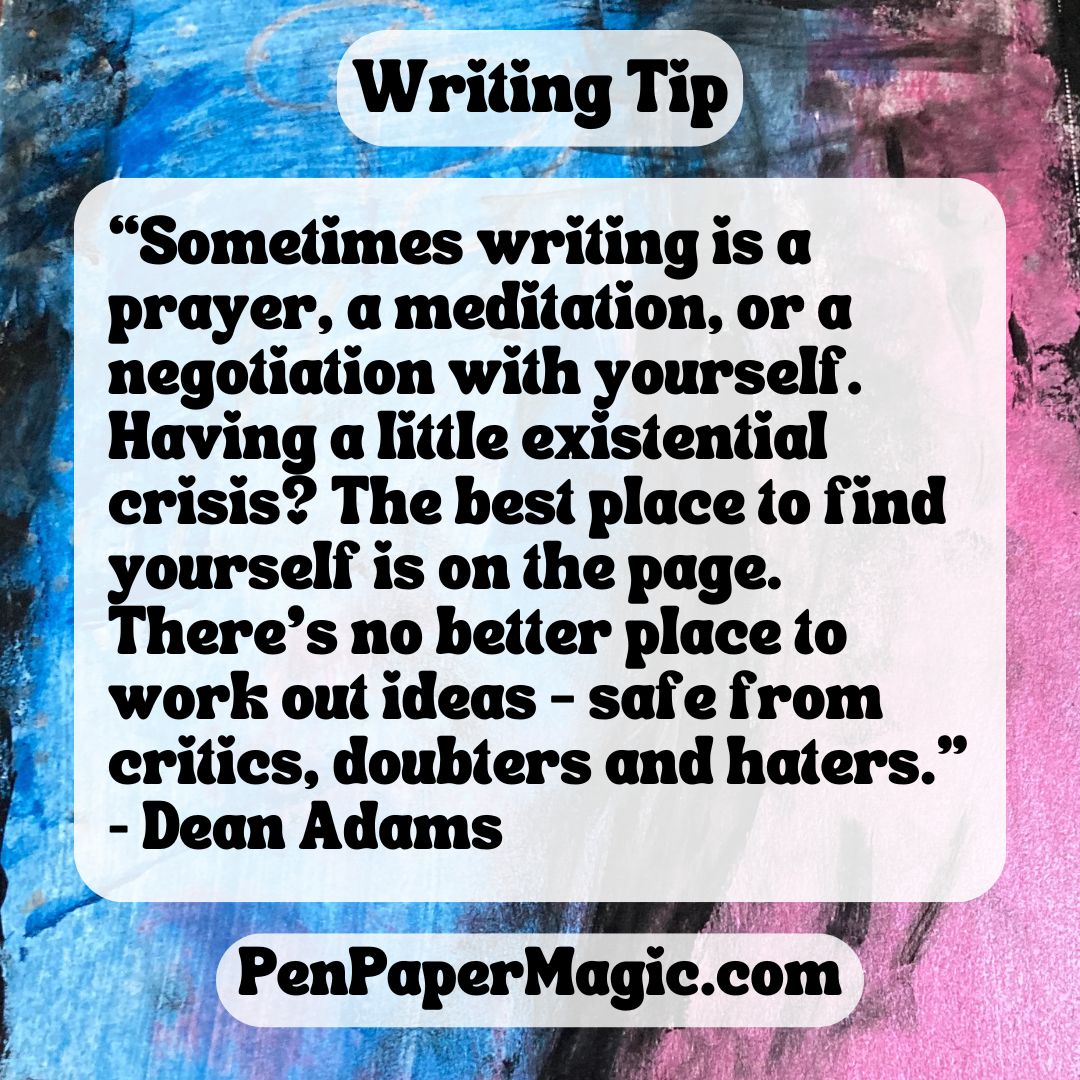
Sometimes writing is a prayer, a meditation, or a negotiation with yourself. Having a little existential crisis? The best place to find yourself is on the page. There’s no better place to work out ideas – safe from critics, doubters and haters.

Putting pen to paper is stepping up and saying yes to the big “I am. I exist.” It’s claiming yourself, your life, your thoughts, your feelings, your power and purpose. It’s more than the very adult sounding “taking responsibility for your life” – it’s an act of radical self-care to honor yourself with the time and effort to really get to know yourself. It’s bravely stepping around our culture’s limiting idea of only some people qualifying for the joy of being a writer or artist, and relegating the rest of humanity to only observing and admiring.

As the pen moves across the page, the topics may range from the mundane to the esoteric. The physical act of writing shifts energy from ruminating thoughts looping over and over to details, emotions, facts, possibilities – words on paper, now more tangible for contemplation and motivation.

I’ve found a positive side effect of a consistent writing practice is better conversations. When I’m not writing regularly, I chit chat more about trivial things, and sometimes feel I’ve wasted opportunities for more meaningful conversations simply because my head isn’t as clear and focused. For me, daily writing gets the negative and petty stuff on the page instead of spreading it around to the people in my life.

After 27 years, I’ve wondered at times if people still need a writing class like mine – especially now with so much of our life being shared on social media. But every time I reach a point where I start to believe that my classes are less relevant, something usually happens that reminds me of the amazing effect of writing in my own life and in my students’ lives. I’ve had former students send me songs that began as a writing exercise in class, email me later to tell me about very real and life-changing epiphanies they had during class or their writing practice that began there… these stories happen often enough that I am steered back to scheduling new classes.

The real beauty, value and purpose of writing, and any art form, is not the final product or the reader’s response. It’s not the branding or the number of readers or attendees or web hits or units sold. It’s the joy of the actual act, even when it feels messy, and the transformation of the writer from the experience. And art will transform you – writing regularly will change your life. That’s why we procrastinate or rush to it, often simultaneously – it’s scary and exciting and shines the light on what we already know: that we must keep evolving. Rapid evolution and radical self-care are really what we all need and what the world needs from us.

To learn more about my classes and coaching please visit PenPaperMagic.com.

The Melodramatic Tree

On a rural road in Southeastern Wisconsin, the Melodramatic Tree sits in front of an idyllic setting of farmland: freshly plowed and planted fields, houses, barns and silos nearby and on the horizon. But the Melodramatic Tree looks burnt black, as if it caught fire, but was put out before it was demolished. And, now, it is forever frozen in a sprawling, gasping reach to the sides and above. The contrast is stark against the reds, greens and blues of nature behind it.

The tree seems to be overreacting to something, and really, who isn’t? Or are we reacting appropriately? It certainly seems justified to splay and sprawl our limbs in outrage over the current state of our world, politics, the economy, the climate or many other issues.

It’s an appropriate response to a wacky, wacky world.

Sometimes the Melodramatic Tree is me. My mind hopping like a skipped stone making ripples, leaving them behind to move onto the next thing.

Sometimes I tease, “What happened to you, emo tree?” And on gorgeous days, I’ll think, “Oh, simmer down, Mel!”

The stories and details have spun in my head and on calls with friends. The nickname is Mel. It is not the giving tree which it calls it the passive aggressive codependent shaming tree. (Yep, I said it.)

I’ve incorporated “Don’t be a Melodramatic Tree about it!” into self-talk and jokes with friends. As in, “Am I being a melodramatic tree about this, and maybe it really isn’t a big deal?”

Maybe the tree is perfectly fine and happy. I’m reminded of Hanna Waddingham’s trick to get over performance anxiety. Before going on stage she makes herself really big – arms and legs spread wide with fingers reaching out, and her face in a big growl. And I notice how big, strong, powerful, and defiant the tree is, and remember it takes courage to take up space. And I say, “Thanks for the encouragement, I’ll stand strong today, too.”

It feels like the Melodramatic tree has more to say. And if not, that’s okay, too. But most days I don’t think the tree is being melodramatic. Most days I drive by and just appreciate the tree and mumble, “Same, tree. Same.”

My Ancestors

“Writing with the Ancestors” (SomaticWriting.com) was the perfect class for me in January. It is a tough month because my mother and sister have passed, and both of their birthdays are in January. My mother passed away in January, and my birthday is in January. 

Also, I’ve had family on my mind because my great-niece is having a baby this summer. Since this is the first child born since my mother has passed, I felt the pressure to do something matriarchal. In my family, that usually meant something crocheted as my mother was an avid crocheter. Thankfully the baby will inherit other baby blankets because my crochet skills are very slow. A blanket would not be done by the time the baby gets here, or, frankly, gets to college.

The idea though, that immediate matriarchal feeling, left me awash in thoughts of family and ancestors and what we give each other – materially and otherwise. And, how I’m someone else’s ancestor and what will I leave for them?  

Continue reading “My Ancestors”

Crocheting and Crying

This year as I celebrate 20 years of teaching Write Your Life as a Woman, I’m sharing some older articles and columns inspired by the class.

Crocheting and Crying
by T. Dean Adams
This article originally appeared in skirt! magazine in 1998.

For the past year I have had the urge to crochet. Though I rarely have maternal urges, the desire to crochet feels similar. My great-aunt Myrt learned to crochet when she retired from fifty years of working at a textile mill. She taught my mother, who has crocheted for as long as I can remember.

In most memories of my mother, she is crocheting; her fingers move a needle in and around yarn in a steady comforting rhythm while she talks. Her fingertips count stitches and she seldom even looks down at what she’s doing. Yarn and a needle are always with her like a pocket book. She can make pretty much anything you can think of: scarves, hats, afghans, little Christmas wreaths and Easter bunnies to wear as pins, frilly collars, shawls and bedroom shoes.

My mother crocheted while she waited for me after dance classes, while she sat through football games to watch me perform with the band at half-time. When I moved to Los Angeles she rode with me and crocheted her way across all the oddly-shaped states slammed up against each other, making delicate cross-shaped Bible markers.

She was crocheting during our last big fight. The one we still gingerly step around. The one that made me feel I’d left the tribe for good and the person I’ve become would never be let back in.

I left my family, my tribe, on my own. I went to college, moved and moved and moved and moved and never even thought of moving back to my hometown. I left the church, left the beliefs I grew up on and became activist. I even left the kitchen – the womb of all comfort and care, where love cannot be denied in a green bean casserole and salmon patties, and became a vegetarian. I write the truth, as best I can, as bravely as I can, about me, my life, my story – which is also their story, for total strangers to read.

Aunt Myrt died last month and I suppose I have known for the last year it would be soon. I knew the day she died, knew when I saw the light blinking on the answering machine with the message from my mom. I loved Aunt Myrt because she loved my mother. She loved me too, but she never knew me the way she knew my mother, who she loved like her own daughter. Having no children of her own, she cared for everyone else’s children. Now grown and spanning the ages of twenty to sixty, the children she’s loved each think they were her favorite.

I finally bought yarn and needles and started a scarf. Never stopping to think, “I don’t know how to do this.” Some odd mother-line osmosis gave me the innate ability to crochet with only a quick glance at instructions. Every time I pick up the needle I have to concentrate at first: around, down, around, pull through, around, pull through two, around, pull through two more. After a few rows my fingers fly and stitch-by-stitch a scarf flows from my hands.

It makes so much sense for me to crochet, I told myself. I can make all my holiday gifts. But when I started the scarf, when I tied my first loop knot to begin, I felt nothing logical. The first stitches, the first rows were like a big sigh after holding my breath. I crocheted and cried. This first purple scarf will be full of wanting. Wanting to be part of my family I feel so far from though geographically they are close.

One row is an apology because I did not go to Aunt Myrt’s funeral. It is a weakness I hope to outgrow, but I cannot go to funerals. I fear the sorrow may consume me and I will never stop crying. There are rows and rows of love. Maternal love, not just from biological mothers, but also the kind my aunt gave my mom, and she gave my sister and me, and we all give to each other.

There is a row of forgiveness for the times my big spirit scared them and they tried to hold me back. And a row of sorrow for the years apart. A row of the things I never told them that I wish I could. Another row of apology for the mean things I said and did and wish I hadn’t.

Around, down, around, pull though, around, pull through two, around, pull through two more. I crochet now to relax, to think, and when I don’t know what else to do. The very act conjures up the spirit of my aunt and my mother and I feel the gift of their love and strength, the hope that forgiveness brings, and the grounded feeling of being true to myself, honoring both what I’ve been given and what I’ve become on my own.

Soon it will be winter, and I know this scarf and the peace it brings will keep me warm.